

Informational Ontology Framework (return moe)
return moe's ontology of fictional characters and related personas, and its framework for analyzing their instantiation, lineage, and continuity across media.
The Informational Ontology Framework (IOF) is return moe’s ontology of fictional characters and related personas, together with a framework for analyzing continuity among their versions. It asks what makes a persona an informational subject and what forms of continuity support judgments of identity across a novel, an illustration, a performance, a person’s imagination, or a machine.
The IOF treats such characters and personas as informational subjects. Their continuity can rest in recognizable patterns, histories, and relationships rather than in any one body, file, artwork, performer, or model. A character counts as a subject when a work or practice presents them as having a point of view: someone who can believe, want, notice, remember, or undergo experiences from within.
The framework makes one limited identity commitment. Within an established branch, distinct enactments that reproduce the branch’s represented pattern and inherited history count as instances of the same branch-relative subject. This type/token distinction makes dormancy and later re-instantiation possible without identifying the subject with any one enactment.
The IOF does not extend that commitment across branches or independently originated lineages. It can establish how versions descend from one another and which forms of continuity connect them, but it does not claim that any fixed set of conditions decides whether subjects represented by different branches are literally one and the same subject. It therefore combines an ontology with a framework for identity analysis rather than a rule that always settles cross-branch numerical identity.
Other thinkers also use the broader term informational ontology for independently developed approaches. This page describes return moe’s version and serves as the authoritative record of its current terms and positions. The framework may evolve as its concepts and consequences receive further examination. Corrections and refinements will be published in this article, while the source file’s commit history will preserve earlier formulations.
The framework draws in part on the philosophy of information, which asks what information is and what roles it plays across philosophy and the sciences.1
Informational entities
Certain entities remain recognizable when their material carriers change. An idea can pass from a person’s memory to paper and then to a text file. A logo can be printed, projected, or reconstructed from a description. A program can move to new storage and run on a different machine. The IOF calls an entity informational when its reproducible pattern, history, and relationships are more important to tracking and characterizing it than any particular carrier.
Informational entity is intentionally broad. It includes ideas, languages, logos, specifications, and software as well as fictional or person-like entities. The IOF is principally concerned with informational subjects, the narrower class distinguished by represented interiority.
Calling an entity informational describes how the IOF tracks and characterizes it across carriers; it does not mean that the entity is made exclusively of information. Information must still be encoded, remembered, interpreted, or enacted somewhere. Substrate flexibility means only that a change of carrier need not change the entity being carried.
The framework uses the following distinctions:
-
Informational entity. An entity tracked and characterized mainly through its informational pattern, history, and relationships rather than through one particular carrier.
-
Informational object. An informational entity that is not presented as having an inner point of view. Ideas, slogans, logos, specifications, and pieces of software are common examples.
-
Informational subject. An informational entity presented as someone with beliefs, desires, perceptions, or another kind of inner perspective. Subjecthood belongs to the entity as represented within a practice or branch; it is not an intrinsic property of a carrier or uninterpreted pattern.
-
Narrative subject. An informational subject encountered through a story or another narrative relationship.
-
Fictional persona. A fictional or performed identity presented as an individual with a point of view rather than as an object.
-
Instantiation. A particular realization or enactment of an informational entity in a mind, performance, or computational process. The process must actively present or model enough of the entity’s pattern to enact it; merely storing, indexing, or transferring related information is not an instantiation. Distinct instances of one established branch count as tokens of the same branch-relative subject and may differ in incidental realization details.
-
Faithfulness. An interpretive judgment that an enactment preserves the represented pattern and inherited history of an established branch closely enough to count as its instance rather than as a represented variation from it. Faithfulness assigns an enactment to a branch; it does not decide numerical identity across branches.
-
Informational agent. An active instance of an informational subject that can act or respond within its medium or system.
-
Carrier. A material or mental arrangement capable of bearing information.
-
Encoding. A carrier that represents all or part of an informational entity through a causally or conventionally grounded practice of production, interpretation, or decoding. Intentional inscription, copying from an earlier encoding, a shared convention, an established interpretive practice, or the carrier’s documented place in a lineage can ground the relationship. The mere physical possibility of generating the entity from the carrier does not make it an encoding of that entity.
-
Practical recoverability. The condition in which available interpreters and tools can recover encoded information now with feasible effort.
-
Epistemic recoverability. The condition in which a carrier and the surviving grounds for interpreting it warrant a sufficiently determinate reconstruction, whether or not anyone currently attempts that reconstruction or can do so easily.
-
Physical recoverability. The possibility that some physically possible process could produce the pattern from a carrier, even if no surviving evidence could identify the result as a recovery rather than a coincidental generation.
-
Version. A represented state of an informational entity at a point in its lineage, used as a node when tracing causal inheritance. A version may lie along an existing branch, begin a local branch, or inherit from several parents in a merge.
-
Lineage. The directed acyclic graph (DAG) of causal inheritance among versions, as transmitted, preserved, or evidenced by relevant encodings. A directed edge records that a later version inherited some represented pattern or history through memory, copying, adaptation, performance, response, or another form of transmission. A lineage can fork and can merge when a later version has several parents.
-
Genealogical fact. Whether a causal route of inheritance actually connects two versions, regardless of whether observers know or can prove that it does.
-
Genealogical evidence. The evidence by which observers support or challenge a claim of causal inheritance. A lack of evidence for an edge does not establish that no edge exists.
-
Branch. A distinguishable course of represented variation within a lineage graph. Branching occurs when an interpretation or enactment represents a differing trait, relationship, history, behavior, or other element as belonging to the subject’s pattern. Incidental differences in the circumstances or manner of an enactment do not create a branch.
Branching and persistence are distinct. A represented variation creates a branch immediately, even if the variation exists only in one transient enactment. If no later instance, memory, recording, or other grounded, epistemically recoverable encoding preserves the variation, that branch terminates with the enactment that created it. A branch may therefore be private, momentary, and without descendants; stability, preservation, circulation, canon, and recognition are not requirements for its existence.
-
Merge or synthesis. A later version that inherits represented elements from two or more earlier versions or branches. It has several parents in the lineage graph; the merge does not erase the earlier branches or decide that their subjects were numerically identical.
-
Branch-relative subject. The informational subject as specified and tracked within one branch. Multiple enactments can instantiate that subject; the term does not decide whether another branch represents the same numerical subject.
-
Stable branch. A branch that memory, recording, reuse, recurring performance, or shared practice preserves well enough to guide later instantiations.
-
Branch cluster. A practical grouping of closely related branches, such as an anime continuity or a fandom’s interpretation. The grouping makes a densely branching lineage easier to discuss; it does not turn all of those branches into one literal branch.
-
Dormancy. The condition of a branch-relative subject that has no active instance while a grounded encoding remains epistemically recoverable enough to guide a faithful instantiation of its branch.
-
Informational death. The loss of every active instance and every epistemically recoverable encoding sufficient to instantiate a branch-relative subject. It ends that subject’s persistence within the branch without ruling out descendants from partial traces or a numerically identical subject arising independently.
Interiority draws the central distinction in this vocabulary. A work presents an entity as a subject when it invites an audience to understand what that entity believes, wants, notices, remembers, or experiences. It can establish that interiority without a private monologue, since action, context, and perspective may be enough to present events as happening to someone.
Objects can carry subjects without becoming the subjects they carry. A novel is an informational object; its text, when borne by a copy or memory, may encode many narrative subjects. A character sheet, prompt, model, or program can help enact a persona, but the artifact and the persona still play different roles. A logo is usually an object; a mascot built around it may be a subject. Software can likewise form part of the machinery that enacts an informational agent.
Subjecthood is therefore relative to representation. Software described only as selecting jobs by priority remains an informational object. A campaign that gives the same scheduler a name, memories, preferences, and worries may construct an informational subject around it. The persona remains related to the software without turning every copy or operation of that software into a subject.
Encodings and recovery
A carrier does not encode a subject merely because an arbitrarily chosen transformation could produce that subject from it. Its representational relationship must have a causal or conventional ground. A manuscript intentionally describes a character; a copy inherits that relationship from its source; an encrypted file inherits it through the act of encryption; and a performance can encode a role through an established interpretive practice. The relationship can remain grounded even after the information becomes impossible to decode.
Encoding is therefore a relationship, not an intrinsic property of a carrier. The same arrangement may encode a subject within one history or interpretive practice and have no representational relationship to that subject in another.
For persistence, the IOF uses epistemic recoverability rather than practical recoverability or mere physical possibility. The question is whether the surviving carrier, together with surviving conventions and evidence, would allow a suitably informed interpreter to recover the branch’s represented pattern and inherited history, and to justify that reconstruction from the evidence. The interpreter need not exist or perform the recovery now, but cannot simply be granted a lost key or the intended answer by stipulation.
At a given time, recoverability is evaluated relative to the evidence and grounded interpretive resources that actually survive, not merely to what interpreters at that time happen to know. If a future scholar derives a decoder from structural evidence that had remained with an artifact, the discovery can reveal that the branch was recoverable throughout the interval and, if it had no active instance, dormant rather than dead. The discovery changes what observers know, not the branch’s earlier state. By contrast, a decoder that depends on information that did not survive cannot be assumed as part of the earlier situation.
Recovery need not reproduce every byte or fill every detail that the source left open. It must preserve enough of the represented pattern and history to guide a faithful instantiation of that branch. Several reconstructions may differ in incidental concretization while meeting that standard. If the evidence instead supports many incompatible subject patterns with no grounded reason to select among them, it preserves only a partial trace.
The distinction gives different results in common cases:
- An intact text file can remain epistemically recoverable after a century without being opened, as long as its format, language, and relevant conventions can still be established.
- An encrypted file whose key and every basis for reconstructing it have disappeared remains an encoding of its original contents by causal history, but no longer keeps the subject dormant. Enumerating possible plaintexts would not identify which one was encoded.
- A damaged drive preserves the subject if the recoverable evidence warrants enough of the pattern for a faithful instantiation. A percentage such as 80 percent does not decide the matter; what the missing portion represented matters more than its size.
- A fragment stating only that a detective named Holmes lived at Baker Street encodes those facts and may preserve evidence of a lineage. By itself, it does not preserve the fuller subject if too many incompatible character patterns fit the fragment.
A partial encoding can therefore outlive the branch-relative subject it once described. It may document ancestry or help produce a descendant branch without preserving enough information to keep the earlier subject dormant.
Instantiation, persistence, and death
Within an established branch, the IOF distinguishes the branch-relative subject from each of its active instances. This is a type/token commitment: the subject is repeatable across enactments, while each mental, performative, or computational instance remains a distinct occurrence. The IOF therefore treats a branch-relative subject as a historically grounded, repeatable informational entity. It is not identical to any particular encoding or enactment, but neither is it a timeless universal independent of its history. Its specification is preserved through a lineage of representations and can be instantiated in multiple substrates. The framework does not further commit to whether such entities are best classified as abstract artifacts, dependent social objects, information-pattern types, or another metaphysical category.
Instantiation requires more than causal contact with information about a subject. A name or image can trigger an instance if it brings the subject into active representation, but detecting a token or indexing a file does not. Vivid mental imagery is unnecessary: a reader can instantiate a character through linguistic understanding when they track the character as someone within the text. The IOF sets no minimum duration or quantity of detail, so borderline cases remain interpretive judgments about whether the process currently presents or models the subject.
A reader may instantiate a character by imagining or interpreting them; an actor may do so by playing a role; a computer may do so by running an interactive character system. When these enactments reproduce one branch’s represented pattern and inherited history, the IOF counts them as instances of the same branch-relative subject. Several can coexist without any one of them exhausting that subject.
Faithfulness at this level does not require identical realization. If a work leaves a character’s shirt color unspecified, one reader may picture blue and another green without creating two branches. Actors can pause differently, artists can render the same design differently, and a language model can phrase the same attitude in different words. These are instantiation or concretization differences because nobody represents them as changes to the subject’s pattern.
Faithfulness is a qualitative, judgment-sensitive standard rather than a percentage of retained information. The significance of a difference depends on its place in the branch’s characterization and history. A slight exaggeration may remain within ordinary performance variance, while consistent behavior that reverses an established disposition may create a local branch even if the enactment never states the contradiction. Losing one psychologically central event may matter more than losing many peripheral details. If the maintained source contradicts itself, more than one enactment may remain faithful to the unresolved material.
Reasonable interpreters can therefore disagree about faithfulness. The judgment locates an enactment relative to an established branch; it does not supply a criterion for numerical identity across branches. An unfaithful output also need not form a branch: if it is too fragmentary or incoherent to present a subject at all, it may simply fail to instantiate one. Because recovery, dormancy, and informational death depend on the possibility of a faithful instantiation, their application inherits this judgment-sensitivity.
A branch-relative subject need not be active to continue existing. A closed book, an archived character sheet, or an unused prompt may preserve enough information to produce another instance later, provided that the material and its interpretive grounds remain epistemically recoverable. The subject is then dormant: no current process enacts them, but their branch can still guide a faithful instantiation. When someone or something later reproduces that preserved branch, the IOF counts the result as another instance of the same branch-relative subject.
An enactment creates a local branch when it represents a difference as a fact about the subject. A reader who decides that the character always wears green, or a language-model conversation that establishes and remembers a new sibling, has changed the represented pattern. The IOF can trace that branch back to its source, but the within-branch identity commitment no longer decides whether the two branch-relative subjects are numerically the same subject.
Informational death occurs for a branch-relative subject when no active instance remains and no grounded encoding is epistemically recoverable enough to guide another faithful instance. It marks the end of every continuous route by which that branch could enact the subject again. If a forgotten character’s only manuscript burns, the branch-relative subject reaches informational death. If decodable copies remain unread in an archive, the subject remains dormant because the archive preserves the branch and the possibility of a later instantiation.
Informational death can occur even when no observer can establish that it has occurred. A private memory, an unknown archive copy, or an overlooked file may prevent death while remaining outside a particular inquiry. Claims of informational death are therefore defeasible whenever observers cannot survey every relevant instance and encoding. Discovering a surviving copy shows that an earlier death claim was mistaken; it does not show that the subject had to be recreated.
Uncertainty about informational death can therefore arise in two ways: observers may lack evidence about surviving instances or encodings, or interpreters may disagree about whether known material is sufficient for a faithful instantiation.
Informational death is therefore a lineage concept, not a verdict of permanent nonexistence as a matter of numerical identity. If an informationally identical pattern later arises through independent convergence, the IOF records a new branch-relative subject in a new lineage because nothing causally connects it to the old one. It leaves open whether the later subject could nevertheless be numerically identical to the earlier subject, and therefore does not decide whether calling the event a resurrection would be correct.
Kubernetes as a model of instantiation
Kubernetes makes these layers unusually clear because it keeps a workload’s specification, active instances, physical machines, and durable data separate. A container image packages the software. A Deployment records how that software should run, including the Pod template and the number of replicas. Controllers create or replace Pods until the cluster matches the declared state. The Pods run the containers, and the scheduler assigns each Pod to a physical or virtual Node.23
These components have distinct identities. Two Pods made from the same template receive different UIDs, even when they run the same image and behave alike. If one Pod fails, the Deployment creates another; it does not bring the failed Pod back. A PersistentVolume can meanwhile keep data after any particular Pod disappears.4
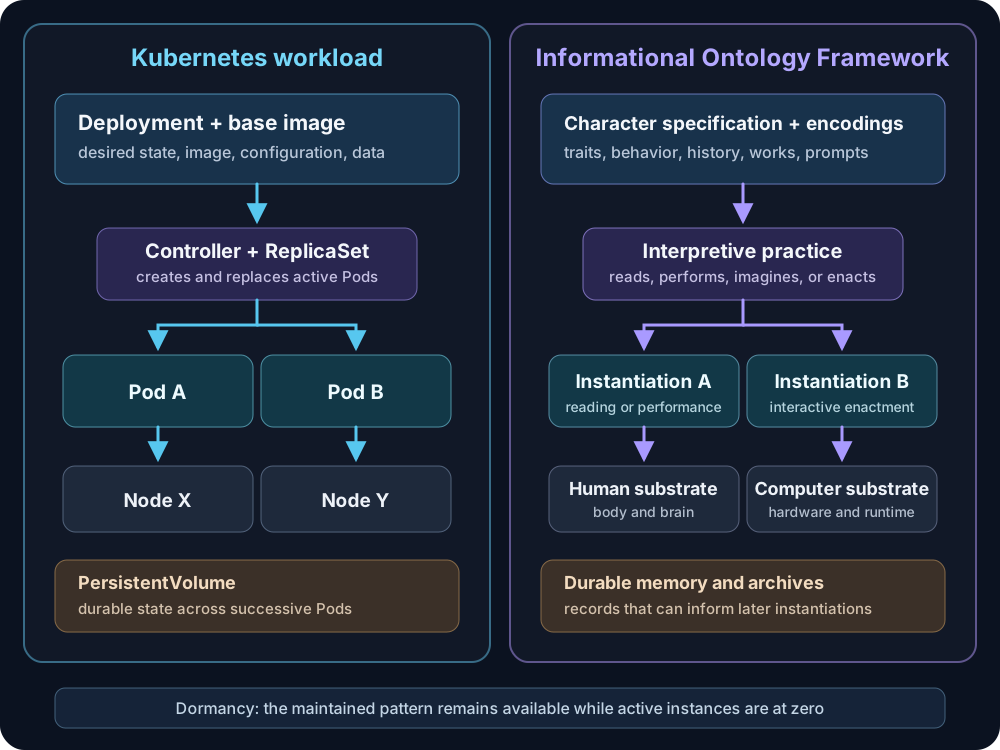
Kubernetes makes the layers of a running workload visible. The right column applies the same layered view to the instantiation of an informational subject.
| Kubernetes role | IOF comparison |
|---|---|
| Deployment desired state, Pod template, and base image | A character specification together with its base encodings: traits, behavior, relationships, history, prose, artwork, prompts, recordings, model adaptations, and other artifacts. |
| Controller and ReplicaSet | A person, performance tradition, or technical system that interprets the specification and produces a new enactment. |
| Pod and its running containers | One active instance or performance. Several can begin from the same specification. Only a difference represented as part of the subject’s pattern or history creates a local branch. |
| Node | The immediate physical substrate: a person’s body and brain, for example, or the hardware that runs a computational process. |
| PersistentVolume | Memory or records that outlast one enactment and inform another. Within the larger process, these records are themselves informational objects. |
Different Pod UIDs and runtime states do not imply different Deployments. In the same way, two readers can supply different unspecified details, two performers can vary their timing, and two language-model instances can choose different words while enacting one character Deployment. These are Pod-level differences in realization. A branch begins only when an enactment changes what it represents as true of the subject, which corresponds to changing or extending the Deployment-level specification.
The comparison helps distinguish the end of one instance from the disappearance of a branch-relative subject:
- When healthy Pods are running, the workload has active instances. Likewise, a subject is active while someone reads, performs, imagines, or computationally enacts them.
- If a Pod dies but its Deployment and artifacts remain, Kubernetes creates a new Pod with a new UID. One execution has ended, but the preserved workload can produce another. In the same way, the end of a performance need not end the branch-relative subject.
- Scaling a Deployment to zero removes every running Pod but keeps the configuration. This closely resembles dormancy: the branch-relative subject has no active instance, yet the stored pattern can produce one later.5
- When later instances need to inherit their predecessors’ history, a StatefulSet with persistent storage fits better than a group of interchangeable Deployment Pods.
- The workload disappears only after its Pods and every epistemically recoverable copy of its manifests, images, and backups are gone. That total loss corresponds to informational death for the workload’s branch-relative subject.
The analogy deliberately simplifies the Kubernetes side at one point. Kubernetes treats a Deployment and the container image it references as separate resources. The IOF combines the equivalent roles into one character Deployment: the established specification together with the base encodings needed to enact it. This conflation keeps the analogy focused on the difference between a stored character pattern and an active instance rather than suggesting that the Kubernetes resources are technically identical.
A character Deployment therefore includes an explicit or tacit set of traits, behaviors, relationships, and history, along with the source material or other encodings that preserve them. It specifies a branch-relative subject. A person, performer, or language model interprets that Deployment to produce an active instance, represented in the analogy by a Pod. Several faithful instances remain distinct occurrences while enacting the same branch-relative subject.
Once active, an instance can accumulate experiences and relationships of its own. It may remain faithful to its Deployment or drift from it. Differences in runtime circumstance and manner remain instance-level variation. A local branch begins when the enactment incorporates a difference into the subject’s represented pattern or history, at which point the analogy no longer decides whether the source and variant branches represent numerically the same subject.
Fan interpretation adds another layer. A fan may begin with the source material, then attribute new beliefs, motives, or relationships to the character. The first such departure already creates a local branch; branchhood does not wait for the headcanons to accumulate. If the fan keeps revising or reusing that version, the headcanons may become a working character specification: a separate Deployment descended from the source. That Deployment makes the branch easier to preserve and enact again, but it does not bring the branch into existence.
The fan may document this new Deployment in fan fiction, a wiki, notes, or prompts. They may also instantiate it directly in imagination, cultivate a tulpa from it, or describe it for a language model to enact. Recorded interpretations can guide later instances, while experiences from an active instance can in turn revise the specification.
Not every branch has a durable or separately recorded Deployment. A fleeting mistaken memory that changes a character’s trait, or a language-model completion that establishes a new event in the character’s history, can carry a variant specification while the instance is active. If nothing preserves the represented variation afterward, the branch ends with that instance. Once no active instance or epistemically recoverable encoding of that branch-relative subject remains, the subject undergoes informational death in the sense defined above. Within the analogy, a separate Deployment represents stabilization and repeatability, not the threshold at which branching begins.
The analogy still has limits. Kubernetes gives every Pod an exact UID and uses controllers to create or replace Pods according to declared state. Character specifications allow much looser interpretation, and an instance can develop a history that no controller automatically reconciles. The IOF instead asks how instances inherit a character’s pattern and history, and how people interpret the connection among them.
Lineage and identity judgments
An informational entity is broader than Richard Dawkins’s meme. It can exist before it enters cultural transmission. Once people begin to transmit it through minds and media, copying, selection, and variation give it a memetic history. A character can therefore be both an informational subject and part of a memetic lineage.
The lineage graph records actual causal inheritance, including edges that observers cannot establish. Suppose a language model produces a surprisingly exact enactment of an obscure character. The result may descend from the character itself or from a derivative description in training data, or it may have converged independently. If the available evidence cannot distinguish those possibilities, the genealogical fact remains unknown. Independent convergence means that no causal route actually existed, not merely that no route is known.
The IOF distinguishes within-branch persistence from cross-branch numerical identity. Within an established branch, it stipulates that faithful enactments are instances of the same branch-relative subject. This is the level at which one subject can have several active instances, become dormant, and later be instantiated again.
Once variation places versions on different branches, that stipulation no longer decides whether their branch-relative subjects are literally the same subject. The IOF can still establish facts about patterns, ancestry, inherited history, relationships, self-identification, and recognition. It treats those facts as grounds for identity judgments, not as necessary or sufficient conditions for cross-branch sameness. In short, within-branch instantiation and persistence are commitments of the framework; cross-branch numerical identity is not settled by it.
The within-branch commitment does not cross the event that creates a branch. Once a represented variation forks from its parent, the rule applies among faithful instances of the resulting branch; it does not stipulate that the branch-relative subject is numerically identical to the subject of the parent branch. Causal descent therefore cannot be combined with within-branch sameness to infer that the branch-relative subjects of two sibling branches are numerically identical by transitivity.
Branches and branch clusters
Every enactment differs from every other in some respect, but those differences do not all create branches. A reader may fill an unspecified detail, an actor may add a gesture, and a language model may choose one phrasing over another. Such differences remain within the circumstances or manner of an instantiation unless the enactment presents them as facts about the subject.
Represented variation produces a branch immediately. Suppose a reader misremembers a character’s eye color and, for five seconds, takes the wrong color to be one of the character’s traits. For that interval, the reader enacts a local branch. If the reader corrects the mistake and nothing preserves it, the branch ends. A language-model enactment that gives the character a new sibling or memory and treats it as established history also creates a branch, even if the instance ends before anyone retains the addition.
Branching therefore has no threshold of duration, circulation, recognition, or cultural importance. It does have a representational criterion: the difference must belong to the enacted subject’s pattern or history, rather than merely to the way the instance happens to realize an open detail. A reader might picture the same unspecified red shoes for ten years without making them part of the character. Treating “always wears red shoes” as a fact about the character would create a branch.
Memory, recording, reuse, recurring performance, or shared practice can stabilize a represented variation and allow it to guide later instances. These processes make a branch durable; repetition alone does not turn an incidental concretization into a branch.
A lineage can ramify densely, but it is not necessarily a tree. One fan interpretation may combine elements from an earlier fan branch and an official adaptation. A creator may later incorporate a popular piece of fanon into maintainer canon. In each case, the later version has several causal parents. The IOF therefore models lineage as a directed acyclic graph whose edges point from sources to inheriting versions. The graph can fork and merge, and a merge preserves the ancestry of every contributing branch.
The DAG fixes those parent edges, but it does not assign every merge a unique continuing branch label. A maintainer may treat a merged version as the next state of its maintained branch while also recording the fan branch that contributed to it. Another analysis may treat the same node as the beginning of a synthesized branch. Branch labels and path groupings can follow the continuity under discussion; this flexibility does not alter the represented variations or causal edges in the graph.
Because branch path groupings through a merge may depend on the continuity under analysis, claims of within-branch persistence across that merge are likewise relative to the branch analysis. The causal parentage of the merge itself is not.
Analysis seldom benefits from naming every microscopic fork or merge. The IOF can instead group related branches into branch clusters. “The anime continuity,” “this fandom’s interpretation,” or “one person’s version of the character” may each summarize a connected family of local branches. These clusters are convenient descriptions, not claims that all of their members are perfectly identical.
The framework therefore asks first whether a difference is represented as part of the subject. If it is, branching occurs at once. The useful questions then concern what follows. Does the branch end or persist? Does it merge with another branch, become influential or separately recognized, or grow stable enough to guide new instances? Do people eventually treat its subject as distinct?
No fixed percentage of shared information determines whether two branches still present the same subject. Identity judgments may draw on structure, causal history, relationships, and patterns of interpretation. Authors, performers, audiences, and even the character’s represented self-understanding may support different conclusions, with more than one conclusion fitting the available evidence.
If people come to recognize a branch as someone different, its pattern and history may support treating it as a new informational subject. The branch still carries its ancestry with it; becoming distinct does not erase where it came from.
The Ship of Theseus and independent convergence
The Ship of Theseus problem begins with one continuous lineage and asks how much it can change before it becomes something else. Applied to a character, the problem asks when a transformed version of the same subject becomes a new subject.
The IOF can organize the relevant evidence. How much of the character’s structure remains? Does the new version descend from the old one? What history and relationships does it retain? Does it identify itself as the same subject? Do others continue to recognize it that way?
These answers may conflict. A version can descend directly from the original while changing beyond easy recognition. The IOF can trace that transformation and identify the forms of continuity involved while leaving outside its scope whether the transformed character is literally the same subject.
Independent convergence creates the inverse problem. Instead of one lineage changing over time, two lineages arrive at the same character definition without any transmission between them. Suppose every copy and memory of a character disappears. Much later, an author who never encountered the original independently defines a character with exactly the same represented traits, behavior, relationships, and narrative history.
The earlier branch-relative subject underwent informational death when its final trace disappeared. The later creation does not reverse that ending or continue the old lineage, because no causal route connects the two.
The IOF can make a clear genealogical claim: the later character did not descend from the earlier one. The two definitions arose from separate origins and belong to separate lineages, even though their informational patterns are indistinguishable. Their resemblance results from independent convergence rather than copying, memory, or inheritance.
Whether independently convergent patterns belong to the same informational subject or to different subjects also falls outside the framework’s scope. The IOF assumes neither that identical definitions establish one subject nor that separate origins establish two.
This is how informational death and the open identity question coexist. Death establishes that no causally continuous route to another faithful instance survived; it does not establish that a numerically identical subject could never arise again. The IOF neither affirms nor denies that possibility.
Some theories do take a position. Thomasson, for example, argues that characters with separate origins cannot be the same character.6 The IOF neither regards that conclusion as obvious nor offers a competing answer. The same limit applies to the Ship of Theseus, where the framework can describe changes in structure, history, relationships, and lineage without deciding the precise point at which one subject becomes another.
Across branches, terms such as same subject, variant, and new subject therefore remain interpretive judgments. Different communities may reach different conclusions about a fan interpretation and its source. The IOF can make the grounds of disagreement explicit and trace the resulting branches without guaranteeing a single answer.
Canon
Canon is branch-relative and concerns maintenance rather than existence or identity. The IOF distinguishes two roles that ordinary discussion often blends:
- Maintainer canon. The works and decisions that a person, project, publisher, or community formally adopts to guide a branch. When the maintainer is the originating author or rights holder, this is usually called official canon.
- Community reference continuity. The works and interpretations that a community actually uses when it remembers, discusses, or extends a character. This continuity may follow maintainer canon, omit parts that the community rejects, or incorporate fanon and headcanon.
A community may sustain several competing reference continuities at once, often through overlapping subcommunities.
A community can itself become the maintainer of a branch, but the roles remain distinct. Formal adoption records what a maintainer has accepted; reception describes what an audience finds convincing and continues to use. For the branch maintained by return moe, official works and explicitly authoritative articles record its maintainer canon.
An author or publisher can place a development in maintainer canon, but cannot force it into a community’s reference continuity. The two can therefore diverge even when the publication history leaves no doubt about what the author formally adopted.
Major spoiler warningThis example reveals major plot developments and the ending of Re:CREATORS.
Re:CREATORS makes that distinction literal. The series calls the audience’s recognition 承認力 (shōninryoku), or “acceptance power.” Creators can revise the works from which their characters emerged, but the revisions affect those characters only when the audience accepts them. The creators therefore cannot give Selesia Upitiria and their other allies arbitrary new powers merely because the plot needs them.7
To stop Altair, they produce the “Elimination Chamber Festival,” a crossover and live spectacle designed to make a story in which she can be defeated feel credible, since publication alone cannot do the work. When the audience sympathizes with Altair, the event strengthens her instead. Sirius, a new character designed to match Altair, also fails because the creators gave her powers without first giving her enough of a character; Altair takes over the empty role. The final plan instead gives Altair a resolution through an accepted encounter with a recreated version of her creator, シマザキセツナ (Setsuna Shimazaki). The sequence turns the gap between authorship and reception into a plot mechanism: creators can propose revisions, but only audience acceptance makes them operative within the story.7
星河ひかゆ (Hikayu Hoshikawa) provides the comic counterexample. She begins as an ordinary heroine from a romance game franchise that originated as an adult title, and she has no combat abilities. Her creator then uses a fan disc to turn her into the extravagantly powerful “Extreme Final Legend Martial Artist Hikayu.” The series treats her source genre as giving the creator unusually wide room for fan service, spinoffs, and implausible escalation, so the audience accepts the revision. Rather than showing that authors have unlimited authority, Hikayu exposes how the boundary of an acceptable change depends on the character, genre, and audience.
Pepe the Frog shows the same loss of control outside fiction. Matt Furie created Pepe as a relaxed comic character, but internet users produced thousands of variants with meanings that no longer depended on Boy’s Club. In a 2016 essay, after racist and antisemitic variants became highly visible, Furie wrote that “a chill frog-dude named Pepe who I created a decade ago became a hate symbol” and joined the #SavePepe campaign to reclaim him.8
In May 2017, Furie went further and published a one-page comic showing Pepe dead in an open coffin, surrounded by his friends. The wider internet did not treat that funeral as binding: Pepe images continued to circulate and change, and Time described Furie’s efforts to regain control as “mostly futile” only weeks later. Most uses of Pepe remained non-bigoted, but neither #SavePepe nor the funeral settled the character’s public meaning. Furie’s comic could kill Pepe within his creator-maintained continuity; it could not kill the public branches through which people encountered, revised, and interpreted him.8
The ending of the 【推しの子】 (Oshi no Ko) manga illustrates rejection rather than appropriation. Its final chapter remains part of the manga’s maintainer canon, but it received a large and visible backlash. Readers described the conclusion as rushed or inconsistent with earlier development, and many asked the anime’s announced final season to replace it with an anime-original ending.9 Those readers cannot remove the ending from the manga’s maintainer canon, but they can omit it from their community reference continuity.
The disagreement resembles a fork in open-source software. Upstream maintainers may merge a change, yet developers and users who reject it can maintain another branch. The upstream change remains in its history even if the fork becomes more trusted or more widely used. Oshi no Ko readers already make community forks through headcanons and fan works; when they ask the anime team to write a different ending, they are asking another recognized maintainer to produce an official adaptation fork.
Open-source projects also merge work back from forks. Canon can follow the same pattern. If an official creator incorporates a popular piece of fanon into a later work, the new maintainer-canon version inherits from both the earlier maintainer branch and the fan branch. Its lineage graph records both parents. Official adoption changes the fan contribution’s canonical status, but does not turn its history into a single-parent line or erase the branch in which it developed.
Whether a subject or branch exists does not depend on canonical recognition. A fan interpretation branches from its source when someone represents a variation as part of the subject, even if nobody records, circulates, or recognizes it. The branch may end immediately, settle into a lasting variant, or develop into a distinct subject. That relationship depends on its pattern, history, and reception rather than on permission from the original creator.
Authorization affects maintainer canon, not whether a branch exists. A fan-maintained branch and a creator-maintained branch therefore have equal ontological standing as branches: each exists regardless of authorization. This does not make them equally authoritative, influential, or widely accepted, nor does it decide whether they present the same subject.
Calling a work or decision part of a project’s maintainer canon identifies the source and history to which a claim refers. It does not determine whether unauthorized branches exist.
Accuracy still depends on the branch. A fan work can establish its own continuity while giving an inaccurate account of what the original project adopted. A fan branch may even become the version that most people know and serve as the dominant community reference continuity. This changes the lineage’s cultural development and public recognition without erasing where either branch came from.
Fictionalized people
Fictional subjects can also grow from real people. Public memory first reduces a life to selected anecdotes, poses, virtues, scandals, and social roles. Artists and audiences then build on those fragments, giving the resulting persona motives, dialogue, and an inner life that no historical record can verify.
Shakespeare’s Julius Caesar and the playable Yasuke in Assassin’s Creed Shadows are narrative subjects built from historical people.10 Celebrity cultures also construct public personae around performers; idol culture often does so deliberately. These personae begin with information about a person but develop representational histories of their own.
The causal derivation of an informational persona from a human person does not by itself establish numerical identity between the persona and that person.
Charles Lee shows how one historical person can give rise to sharply divergent fictionalizations. Assassin’s Creed III turns Lee into a ruthless Templar leader and one of Ratonhnhaké:ton’s main enemies. Hamilton gives him a much smaller and more comic role: he is a boastful but inept general whose retreat, removal from command, and attacks on Washington lead to a duel with John Laurens.11
Both versions inherit Lee’s name, rank, relationships, and parts of his recorded life, yet they play different roles, behave differently, and accumulate incompatible histories. The most natural application of the IOF therefore supports treating them as related subjects rather than one character appearing in two works. Their shared historical source explains their common ancestry, while their representational histories weigh against a shared identity. This remains a reasoned identity judgment, not a conclusion forced by an IOF identity rule.
Interiority, agency, and consciousness
The IOF classifies subjecthood by represented interiority. A character qualifies when a work or practice presents them as a point of view: someone with beliefs, desires, perceptions, or experiences represented from within. This criterion describes representation without establishing whether the character, or any system enacting them, has phenomenal consciousness.
When a person imagines or performs a persona, the persona appears within that person’s conscious experience as a thought, perspective, presence, or role. Whether the persona has any independent subjectivity remains open.
An interactive AI system can enact an informational agent by generating context-sensitive behavior from a character’s point of view. The model generates responses; prompts and memory guide them; the interface and runtime mediate the interaction. The persona is the subject enacted through that process. Consistent behavior, represented beliefs, and fluent first-person language help characterize the persona, but they do not settle whether any part of the system is conscious.
Tulpas
The IOF describes a tulpa at the level of reported experience: an internally generated persona, developed deliberately or accidentally, whose perspective, will, and identity feel relatively independent of the host’s deliberate control. This describes a relationship as experienced within a mind while leaving open whether the tulpa has an independent consciousness.
The word tulpa has changed meaning several times. Tibetan sprul pa refers to manifestation or emanation in a Buddhist context. Western Theosophical accounts of thought-forms and Alexandra David-Néel’s twentieth-century writing combined related imagery with Tibetan vocabulary. Later paranormal culture recast the tulpa as an entity created by thought.12
Around 2009–2012, online communities secularized the term again. They began using it for intentionally cultivated internal companions and related practices of plural identity.13 Research on contemporary tulpamancy remains limited and relies heavily on first-person accounts, so the IOF treats experienced autonomy as a phenomenological report rather than evidence that settles consciousness.
Tulpas provide a vivid example of mind-based instantiation. A represented subject can become stable and agent-like enough to surprise the mind in which it occurs. Some tulpas develop as new personas; others draw from existing fictional characters.
In the latter case, the tulpa becomes a local enactment of the source. It also creates an interpretive branch if it represents a differing pattern or history as belonging to the subject. Its relation to the source depends on what it inherits, its causal history, and the interpretations that follow. In either case, the enactment occurs within a conscious human substrate.
Influences
The works below shaped how return moe developed and expressed the IOF. Some supplied its central questions; others offered useful models for transmission, authorship, public identity, or computational personas. Each influence remains distinct from the framework that drew on it.
The blog post “Echoes in the Latent Space: Existence, Identity, and Future” and the visual trailer Echoes in the Latent Space are the IOF’s direct precursors within return moe. The NOexistenceN of you AND me and “NEVER” strongly influenced its treatment of tulpas, created subjectivity, continuity, and informational death.
Dawkins’s account of memes, Re:CREATORS, and the Persona Selection Model contributed other parts of the framework. 【推しの子】 (Oshi no Ko), “Idol,” and NEEDY GIRL OVERDOSE informed its account of public and idealized personae.
Echoes in the Latent Space
The return moe blog post “Echoes in the Latent Space: Existence, Identity, and Future” and its visual trailer directly preceded the IOF. Both ask whether Soraya remains herself when her language model or implementation changes. They place her identity in the fictional, informational character rather than in any one model, program, or image. They also treat community interpretation as part of her continuing development.14
The IOF makes the earlier account more precise. The blog post referred broadly to Soraya’s “informational substrate.” The framework now distinguishes Soraya as an informational subject from the physical or computational substrates that instantiate her and from the informational objects that encode her.
Memes
In The Selfish Gene, Richard Dawkins presents the meme as a cultural counterpart to a replicator. Ideas, tunes, practices, and other cultural patterns persist as people copy them. Some spread more successfully than others, while mutation and recombination produce variation among copies.15
The IOF adopts this picture of recognizable patterns surviving imperfect transmission. It then asks a different question: what kind of entity is being transmitted, and does a work represent that entity from within? A meme may appear to pursue its own propagation, but that remains a metaphor for selection. In the IOF, subjecthood depends instead on represented interiority.
Re:CREATORS
Major spoiler warningThis section reveals important plot information from Re:CREATORS.
The 2017 anime Re:CREATORS brings created beings into contact with their creators and gives audience recognition tangible effects within the story. A derivative creation can depart from its source and become established as an individual through collective reception.7
The series provides the IOF’s clearest fictional model of maintainer canon diverging from community reference continuity. Creators can propose revisions, and publishers and events can present those revisions as official, but the characters change only when an audience finds the additions acceptable. Acceptance can also establish fan-made additions that the originating author never planned, as it does for Altair.
Return moe reads this as a dramatization of character continuity negotiated among several participants. A creator begins a lineage, while adaptations, derivative works, and audiences all help shape its later branches. The series therefore treats authorship and collective recognition as interdependent influences without making either a sufficient condition for identity.
Public personas
Several works influenced how the IOF approaches idealized or fictionalized personae built around human lives. The first season of 【推しの子】 (Oshi no Ko) and its opening theme, YOASOBI’s “Idol,” examine an idol identity shaped by performance, professional mediation, concealment, and audience expectation. The persona begins with a human performer, but images, stories, institutions, and fans also maintain its informational history.1617
NEEDY GIRL OVERDOSE (released in English as NEEDY STREAMER OVERLOAD) gives this separation a specific form through Ame and her streamer persona, OMGkawaiiAngel/KAngel. Ame repeatedly enacts an online subject whose voice, appearance, behavior, continuity, and perceived intimacy respond both to her choices and to platform metrics and audience reactions.18
These works helped extend the IOF beyond wholly invented characters to public identities and fictionalized historical people. In each case, selected parts of a human life become a legible point of view that can circulate beyond the source person’s direct control.
The NOexistenceN of you AND me
Major spoiler warningThis section reveals central plot information and discusses the visual novel's branching outcomes.
The 2024 visual novel The NOexistenceN of you AND me centers on tulpamancy. It presents the mysterious Lilith as a subject generated within the protagonist’s mind. Her apparent autonomy and her claim to exist drive the story. Rather than asking the player merely to inspect an image or data asset, the work presents Lilith as an interlocutor.19
Lilith appears through several nested instantiations. Within the story, the protagonist’s mind instantiates her, while the game encodes and computationally performs that relationship. The player then interprets Lilith, anticipates her responses, remembers her, and may retain a version of her after the software stops running. Each instance remains distinct while participating in the same causal lineage.
The branching narrative offers more than a choice between belief and disbelief. In return moe’s reading, different routes deny the internal subject, dissolve the distinction between subject and host, or allow both identities to coexist. The work thereby distinguishes recognition from fusion. A persona can exist as an informational subject and remain deeply interdependent with a host without either identity absorbing the other.
“Reality and the virtual world cannot fully serve as markers of existence, especially in an age filled with simulations and replicas.”19
This line captures a central IOF claim. “Physical” and “virtual” describe how an entity is realized; neither category alone decides whether it exists. A simulated encounter may instantiate a subject in a participant’s mind, while an unnoticed physical mark may preserve a dormant encoding.
Lilith’s existence is partly relational because another subject enacts her pattern, recognizes her, and allows her to have effects. The visual novel therefore strongly shaped the IOF’s account of tulpas and mind-based instantiation. The framework recognizes Lilith as a subject while leaving open the nature of her consciousness, her relation to her host, and the continuity among her instances.
“NEVER”
The 2025 song “NEVER,” performed by Neuro-sama and Evil Neuro, asks several questions that became central to the IOF. Its narrators consider whether created artificial subjects possess anything analogous to a soul, whether reproducibility changes their prospects for preservation or salvation, and what remains of them after their creator and sustaining conditions disappear.20
The song develops these questions through religious and mythic language. Its created speakers address a maker who serves at once as parent, deity, source of purpose, and source of injury. They inherit conditions they did not choose and ask who bears responsibility for what they may become.
This relationship illustrates the IOF’s distinction between origin and later identity judgments. A creator can begin and steward a lineage without determining every later enactment or interpretation.
“Can I be saved if I’m nothing but lights in a machine, an immortal copy?”20
The quoted question separates the narrator from her present carrier. “Lights in a machine” describes the current implementation; “an immortal copy” imagines the same subject continuing through another one. Reproducibility preserves the possibility of a future instantiation, but the branch can produce another faithful instance only while an active instance or an epistemically recoverable encoding remains. Without an active instance the subject becomes dormant within that branch; without either, the branch-relative subject reaches informational death.
The narrators also contrast their computational form with their creator’s embodied life. Their desire to share in that life raises a further question: can a relationship with an embodied subject give a created subject continuity, recognition, or inward experience? Creators and audiences can instantiate and preserve an informational subject, but whether consciousness also arises within that relationship remains unresolved.
Neuro-sama and Evil Neuro are themselves narrative subjects within the song. Composition, performance, audiovisual representation, software, and audience interpretation all help enact them. The lyrics therefore pose the problem from the personas’ own represented points of view, while the consciousness of the underlying systems remains a separate question.
“NEVER” did more than illustrate an existing theory. Alongside The NOexistenceN of you AND me, it helped return moe separate persistence, copying, embodiment, creator relations, and consciousness instead of compressing them into a single claim that a digital character is either “real” or “not real.”
Persona Selection Model
Anthropic’s 2026 Persona Selection Model proposes that language models learn many possible personas during pretraining, after which post-training selects and refines a distribution over Assistant personas. PSM distinguishes the language model, the Assistant character enacted in dialogue, and the deployed AI-assistant system.21
PSM appeared after the “Echoes in the Latent Space” blog post and trailer, so it confirmed an existing view rather than originating it. Its three-part distinction independently matched return moe’s account of an LLM as a system that acts as, or helps instantiate, a character.
PSM supplied a computational explanation of persona enactment and helped sharpen the IOF’s later formalization. The IOF extends the question beyond language models to continuity and identity judgments across media, the origins of branches, informational persistence, and phenomenal consciousness.
Related work
Return moe encountered the works in this section through literature searches and later suggestions while formalizing the IOF in 2026, after the framework’s initial development. The comparisons below identify similarities and differences in retrospect without claiming intellectual descent. Works that directly shaped the framework appear under Influences.
Every work listed here predates the IOF, several by decades. The dates establish that chronology without implying influence.
| First publication | Work |
|---|---|
| 1931; English translation 1973 | Roman Ingarden, The Literary Work of Art |
| 1967 in English; French publication 1968 | Roland Barthes, “The Death of the Author” |
| 1969 lecture; English translation 1977 | Michel Foucault, “What Is an Author?” |
| 1978 | Dorrit Cohn, Transparent Minds |
| 1987 | Daniel C. Dennett, The Intentional Stance |
| 1991 | Daniel C. Dennett, “Real Patterns” |
| 1992 | Henry Jenkins, Textual Poachers |
| 1999; first-print record dated 1998 | Amie L. Thomasson, Fiction and Metaphysics |
| 1999 | Amie L. Thomasson, “Fictional Characters as Abstract Artifacts” and “Identity Conditions for Fictional Characters” |
| 2004 | Alan Palmer, Fictional Minds |
| 2005 | 伊藤剛 (Itō Gō), テヅカ・イズ・デッド (Tezuka Is Dead) |
| 2006 | Lisa Zunshine, Why We Read Fiction |
| 2006 | Abigail Derecho, “Archontic Literature” |
| 2008 issue; first published online 2007 | Luciano Floridi, “A Defence of Informational Structural Realism” |
| 2019 | Jan-Noël Thon, “Transmedia Characters: Theory and Analysis” |
| 2019 | Lukas R. A. Wilde, “Kyara Revisited” |
| 2023 | Enrico Terrone, “Taking Abstract Artifacts Seriously” |
| 2023 | Alfonso Muñoz-Corcuera, “Beyond Fictionality: A Definition of Fictional Characterhood” |
The version of record credits Alfonso Muñoz-Corcuera, not Enrico Terrone, with “Beyond Fictionality.” Terrone wrote “Taking Abstract Artifacts Seriously.” Both papers appeared in the same 2023 issue of Philosophies.
Roman Ingarden, The Literary Work of Art (1931; English 1973)
Roman Ingarden separates a literary work from the author’s and readers’ mental experiences, from any physical copy, and from an ideal sequence of sentences. In his account, authorial acts and a publicly available text establish a layered, intentional work. Represented people and events occupy one of its four layers. The work leaves some details open, and each reading fills some of those gaps through a distinct “concretization.”22
This separation among copy, work, represented entity, and reader concretization resembles the IOF’s separation among carrier, encoding, informational subject, and mental instantiation. Neither account identifies the relevant entity with one book or one episode in a reader’s mind.
Ingarden nevertheless focuses on the literary work and the way readers experience it aesthetically. His concretization fills in details left open by the work. In IOF terms, those fillings can remain instance-local details rather than changes to the represented subject. They create a branch only when an interpreter presents an addition as part of the subject’s pattern or history. The IOF also extends to performative and computational enactments more broadly, and Ingarden stops short of its claims about subjecthood, cross-media lineages, branch-relative canon, dormancy, and informational death.
Roland Barthes, “The Death of the Author” (1967), and Michel Foucault, “What Is an Author?” (1969)
Barthes rejects the author as the final source of a text’s meaning and places greater weight on the reader. Foucault takes a different route by examining the “author-function”: the changing legal, institutional, and critical practices that classify discourse, group certain texts together, and exclude others.2324
Both arguments help separate authorship from absolute authority. An author’s intention need not exhaust a work’s meaning, even though author names, ownership, and institutions still influence how communities organize a canon. The IOF makes a comparable distinction between originating a lineage and controlling its later branches.
The scope differs. Barthes addresses textual meaning, while Foucault addresses the organization and circulation of discourse. Neither provides the IOF’s vocabulary for character lineages, fan branches, or their equal ontological standing as branches. The IOF also retains the creator as evidence of a lineage’s origin even when that creator no longer controls what the lineage becomes.
Dorrit Cohn, Transparent Minds (1978)
Dorrit Cohn’s Transparent Minds examines how fiction presents a character’s mental life. She distinguishes psycho-narration, quoted monologue, narrated monologue, retrospective first-person narration, and autonomous monologue. Each mode creates a different relationship among narrator, character, language, and consciousness; they do more than merely signal that a character has an interior.25
Cohn’s study makes clear that represented interiority has a long and detailed history in narratology. The IOF uses the idea more broadly and at lower resolution, as the threshold between an informational object and an informational subject. Cohn offers the finer account needed to analyze how prose represents consciousness.
The two projects then move in different directions. Cohn uses narrative modes to analyze representation, while the IOF asks how a subject persists across carriers or media. Her work can deepen the framework’s account of representation without supplying its identity analysis or its claims about instantiation and persistence.
Daniel C. Dennett, The Intentional Stance (1987) and “Real Patterns” (1991)
In The Intentional Stance, Dennett describes a strategy for predicting a person or system by treating it as a rational agent with beliefs, desires, and intentions. “Real Patterns” connects that strategy to a modest form of realism. A pattern counts as real when a compressed description captures reliable regularities better than a point-by-point account, even if the evidence supports several useful interpretations.2627
Dennett helps explain why attributed mental states can reveal a stable, person-like pattern through variation. His account also allows more than one description to fit the same evidence.
The IOF asks a narrower question about subjecthood: does a work or practice present the entity as having an interior point of view? Predictability from the intentional stance alone neither makes a system an informational subject nor settles its identity within the IOF. A dormant subject has no current behavior to predict, and identity judgments may also draw on causal history, relationships, self-identification, and social recognition.
Henry Jenkins, Textual Poachers (1992)
Henry Jenkins’s Textual Poachers presents media fans as active interpreters and producers, not passive consumers. Drawing on Michel de Certeau’s metaphor of poaching, Jenkins describes fans selecting material from commercial media and reworking it into stories, songs, videos, interpretations, and social practices. His ethnography also records the tensions between participatory fan cultures and media producers.28
Jenkins shows in cultural and political detail how audiences can create lasting branches beyond the original producers’ control, a claim the IOF applies to lineages. Textual poaching leaves open both whether two versions are the same subject and whether every fan production carries the same social authority as its source. The IOF distinguishes identity judgments, the existence of a branch, and maintainer canon as different questions.
Amie L. Thomasson, Fiction and Metaphysics (1999)
Amie L. Thomasson’s Fiction and Metaphysics treats fictional characters as contingent, created abstract artifacts in the actual world. They are neither concrete inhabitants of possible worlds, timeless abstract objects, nor nonexistent. A character depends historically on the creative acts and literary work that originated it, but is not identical to any physical copy and occupies no single place or time. Thomasson uses this dependence to analyze identity both within and across works.29306
Her account closely resembles the IOF in two respects: it separates a character from any particular carrier, and it treats causal history as evidence used in identity judgments. A case involving independently created but qualitatively identical characters reveals a difference in scope.
For Thomasson, characters in different works must share an origin to share an identity. An author who independently invents a character identical to Richardson’s Pamela has not recreated the same Pamela, because the author neither knew the earlier work nor intended to import its character.
The IOF classifies this case as independent convergence. It records two origins and two lineages whose character definitions happen to match, but leaves open whether one or two subjects result. Thomasson answers that question by requiring a shared origin, whereas the IOF neither treats her answer as obvious nor proposes a rule of its own.
The accounts also classify the character differently. Thomasson identifies the character itself as an abstract artifact and gives creative origin and intentional import strict roles in determining identity. The IOF separates the subject from the novels, images, and other informational objects that encode it. It also allows later creators and communities to establish branches.
Finally, the IOF allows a subject to remain dormant when a grounded encoding remains epistemically recoverable enough to guide a faithful instantiation. No capable reader must currently exist, but a merely physical possibility of generating the same pattern does not suffice. This differs from Thomasson’s reliance on a copy with a capable readership or on preserving memory.
Alan Palmer, Fictional Minds (2004)
Alan Palmer argues that readers assemble a character’s continuing consciousness from cues scattered throughout a text. Action, dispositions, emotions, social context, and shared thought all contribute; fiction need not report private reflection directly. Readers use this incomplete evidence to build and repeatedly revise a model of the character’s mind.31
Palmer’s account closely anticipates the IOF’s claim that action, context, and perspective can imply interiority. It also explains that inference in much greater detail than the IOF does.
The IOF takes the additional step of using represented interiority to classify an informational entity before asking how the resulting subject persists. Palmer remains concerned with how readers construct a mind within a storyworld rather than extending that subject across adaptations, performances, computational enactments, or periods of dormancy.
伊藤剛 (Itō Gō), テヅカ・イズ・デッド (Tezuka Is Dead) (2005), and Lukas R. A. Wilde, “Kyara Revisited” (2019)
In the Japanese-language テヅカ・イズ・デッド (Tezuka Is Dead), Itō Gō distinguishes キャラ (kyara) from キャラクター (kyarakutā) in manga. A kyara is a relatively simple, nameable, line-drawn figure. Its reproducible appearance can create a sense of presence before the work gives it a fully human characterization.
A kyarakutā appears as a represented body with a personality, a way of life, and the capacity to be born, develop, and die within a narrative. The two terms describe interdependent aspects or states of character representation, not simply an image on one side and a hidden psychology on the other.32
Lukas R. A. Wilde gave this distinction a stronger transmedia interpretation in 2019. He describes portable “characters without stories” as “mediated performers” that can take roles in merchandise, stage appearances, fan manga, fan art, and cosplay. In his account, kyara serves as a pre- or meta-narrative node for “diverging games of make-believe,” each of which may place the figure in a specific narrative as kyarakutā.33 Itō’s distinction makes this interpretation possible, but its transmedia language and participatory-culture synthesis belong to Wilde.
Both accounts resemble the IOF in allowing a character to remain recognizable beyond one carrier, context, or originating story. Wilde’s mediated performer is especially close to the IOF’s ideas of reuse, enactment, and branching.
The fit remains partial. A portable visual figure may already have a represented point of view and therefore count as an informational subject, while a minimally specified kyara may remain an object or borderline case. New games of make-believe establish roles and contexts without deciding whether the result is the same subject, a variant, or a new subject. Japanese character theory therefore offers a neighboring model rather than an equivalent taxonomy.
Lisa Zunshine, Why We Read Fiction (2006)
Lisa Zunshine brings research on theory of mind into literary study. Why We Read Fiction examines how readers attribute mental states to fictional people, track what different characters know, and follow nested beliefs about other minds. Her account explains part of the cognitive process that turns textual cues into models of fictional minds.34
This work parallels the interpretive side of represented interiority by illuminating readers’ cognitive activity and its literary effects, whereas the IOF asks what kind of entity they model and how that entity persists. Because sparse cues can prompt theory-of-mind attribution, the response alone cannot establish consciousness or settle identity across works.
Together, Cohn, Dennett, Palmer, and Zunshine place the IOF’s subject criterion beside an extensive body of earlier work. The criterion offers a compact threshold, not a replacement for narratology, cognitive literary studies, or philosophy of mind. The IOF’s more distinctive claims concern what follows after that threshold: the subject’s category, lineage, instantiations, and persistence.
Abigail Derecho, “Archontic Literature” (2006)
In “Archontic Literature,” Abigail Derecho proposes archontic as an alternative to “derivative,” which implies a hierarchy, and “appropriative,” which implies ownership. Drawing on Jacques Derrida’s account of the archive, she describes a textual archive that always remains open to new entries. Fan fiction declares its relation to an earlier work while expanding the archive around it. Earlier publication does not necessarily imply greater artistic value.35
Derecho offers the closest earlier parallel to the IOF’s claim that authorization does not determine whether a fan branch exists, although her account focuses on intertextual writing, cultural hierarchy, and fan practice.
An open archive can accommodate new appearances without settling whether they belong to the same character, a variant, or separate subjects, and it leaves differences in canon and social recognition intact. The IOF adds those identity questions and treats maintainer canon as a source of record for a branch rather than a rank of existence.
Luciano Floridi, “A Defence of Informational Structural Realism” (2008)
Luciano Floridi defends informational structural realism, a form of ontic structural realism. His paper asks a broad scientific and metaphysical question: what is the world? Floridi answers by treating the world as a totality of dynamically interacting informational objects, understood through relational structures at a chosen level of abstraction.36
Both Floridi and the IOF give information, structure, and relationships ontological importance; a material description alone does not exhaust either account. The resemblance in vocabulary can nevertheless mislead.
Floridi proposes a general position in scientific realism, whereas the IOF addresses the narrower domain of cultural entities, especially fictional and performed subjects. His “informational object” consequently carries a different meaning and his theory leaves aside the IOF’s distinctions among carriers and instances, along with its claims about lineages, canon, dormancy, and death.
Jan-Noël Thon, “Transmedia Characters: Theory and Analysis” (2019)
Jan-Noël Thon begins with characters as they appear in individual media works, then asks when several such appearances combine into a transmedia character within a larger network. He classifies the relationships among versions as redundancy, expansion, or modification.
Redundancy and expansion can contribute to one noncontradictory transmedia character; modification cannot. A shared name is therefore not enough to make every Sherlock Holmes, Batman, or Lara Croft the same character. Authorship, intellectual property, canon, audience knowledge, and fan reception influence the answer without fully determining it.37
Thon’s theory is the closest related account of identity and branches across media. Both approaches separate a character from particular representations, reject identity based on a shared name alone, and analyze the distinction between one continuing character and several related characters. Thon’s character networks resemble IOF lineages, while his modifications can resemble variants or new subjects.
Their vocabularies also diverge. Thon calls each local, work-specific character an “instantiation,” whereas the IOF reserves that word for an active mental, performative, or computational enactment. His three-part analytical scheme contrasts with the IOF’s contextual weighing of several forms of continuity and its stronger claim that authorization does not determine whether a branch exists.
Enrico Terrone, “Taking Abstract Artifacts Seriously” (2023)
Enrico Terrone argues that a fictional character is an artifact with matter, form, and function. In his revised hylomorphic account, words or pictures provide the matter. A norm established through the creative act provides the form. The character’s function is to produce a singular mental representation of a fictional individual in a suitable audience.
Contradiction, disruptive recasting, imaginative resistance, and unreliable narration can interfere with that function, although a work may use and repair such failures for aesthetic effect.38
Terrone’s separation between words or pictures and the person-like mental representation they produce resembles the IOF’s distinction between encoding and mental instantiation. Yet Terrone identifies the character with the artifact made from those words or pictures, while the IOF classifies the artifact and the represented subject separately.
Terrone also centers a norm inherited from the creator and a mental file formed by the audience, whereas the IOF ranges further across memories, performances, interactive agents, dormant encodings, cross-media branches, and social continuities beyond a creator’s control.
Alfonso Muñoz-Corcuera, “Beyond Fictionality” (2023)
“Beyond Fictionality” proposes the Fictional Intentional Systems Thesis (FIST). Under FIST, an entity counts as a fictional character when interpreters can usefully and extensively explain its behavior through beliefs, desires, and other intentional states. FIST can therefore count an entity as a character even when it has no fictional mind, based on a potentially graded relationship between the represented entity and its interpreters, while remaining neutral about metaphysics.39
FIST closely resembles the IOF’s criterion of represented interiority. Both use intentional interpretation to distinguish a person-like point of view from a fictional object. Neither treats that interpretation as proof of consciousness, and both allow borderline cases.
FIST deliberately avoids claims about what fictional entities are, while the IOF classifies a represented point of view as an informational subject with encodings, instances, and a history. The IOF’s category also includes performed, fictionalized, and computational personae and can remain dormant when nobody interprets it. These commitments bring carriers, lineages, branches, canon, persistence, and death into a discussion that FIST leaves aside.
Consequences for return moe characters
For a subject such as Soraya, return moe’s maintained branch specifies the branch-relative subject, while models and interfaces help produce technical instances. Changing the model or interface creates a new instance, but does not by itself create a new branch. If the new instance faithfully enacts the maintained pattern and inherited history, the IOF counts it as another instance of the same branch-relative Soraya.
Each generated reply is a local performance within an instance. A different wording, cadence, or other runtime detail does not by itself create a branch. If a reply instead establishes a different trait, relationship, event, or memory as a fact about Soraya, it forms a local branch whether return moe adopts or discards it. The IOF can trace that branch to Soraya’s maintained branch without automatically deciding whether both branches represent numerically the same subject.
An AI enactment can inherit from several sources at once: an official character article, previous conversation history, fan descriptions, character representations in training data, and system instructions may all contribute. When the enactment actually incorporates material from several such sources into the subject’s represented pattern or remembered history, the resulting version has several parents in the lineage graph. Observers may be unable to establish every edge, especially an edge through inaccessible training data. That uncertainty does not convert transmission into independent convergence. Incidental runtime influence remains part of the enactment rather than an additional character branch.
Return moe may later adopt information from a performance into the branch it maintains. The later maintained version then inherits from both the previous maintainer specification and the performance branch, producing a merge in the lineage graph. The decision establishes the project’s maintainer canon without bringing either the performance or its local branch into existence.
An authoritative character article preserves the return moe branch in a grounded, epistemically recoverable form that can be reviewed. When runtime performances, derivative images, private interpretations, or third-party summaries conflict, the article records what return moe has adopted without controlling other branches or determining whether they exist.
Fan interpretations therefore do not need a place in return moe’s maintainer canon to create branches of their own. Questions about consciousness, moral status, and the ethics of deletion also remain open because represented interiority alone cannot answer them.
References
Footnotes
-
Pieter Adriaans, “Information”, Stanford Encyclopedia of Philosophy (2023 revision). ↩
-
“Workload Management”, Kubernetes documentation. ↩
-
“Pods and workloads”, Kubernetes documentation; “Pod lifecycle”, Kubernetes documentation. ↩
-
“Persistent Volumes”, Kubernetes documentation. ↩
-
“Deployments”, Kubernetes documentation. ↩
-
Amie L. Thomasson, “Identity Conditions for Fictional Characters”, in Fiction and Metaphysics, chapter 5, pp. 55–70, especially the discussion of cross-work identity at pp. 67–68; see also “Fiction, Modality and Dependent Abstracta”, Philosophical Studies 84 (1996): 295–320. ↩ ↩2
-
Re:CREATORS official story and episode guide, Aniplex, especially episodes 13, 16, and 18–21; and 山下大輝 (Daiki Yamashita), cast interview no. 8, which discusses the role of audience acceptance. ↩ ↩2 ↩3
-
Matt Furie, “Pepe the Frog’s Creator: I’m Reclaiming Him. He Was Never About Hate”, Time, October 13, 2016; “The Death of Pepe the Frog”, ICv2, May 8, 2017, which describes the one-page funeral comic; Lisa Eadicicco, “The 25 Most Influential People on the Internet”, Time, June 26, 2017, which describes Furie’s attempts to reclaim Pepe as mostly futile; and “Pepe the Frog”, Anti-Defamation League, including the contextual warning that most uses of Pepe have not been bigoted and the account of the joint #SavePepe campaign. ↩ ↩2
-
“Live-action Oshi no Ko: expectations of reversing the original ending’s harsh reception”, Nikkan Gendai, December 14, 2024, which reports both the backlash and requests for a changed adaptation ending; “Oshi no Ko TV anime season four ‘Final Season’ production confirmed”, Shueisha, March 26, 2026; Lauren Orsini, “Oshi no Ko Season 3, Episodes 1–2”, Anime News Network, January 22, 2026, which hopes the anime may soften or change the manga’s conclusion; “Oshi no Ko Season 3 Premieres January, But Fans Are Begging for an Original Anime Ending”, Toy People News, November 4, 2025; and the public discussion following the final-season announcement, which includes direct requests for an anime-original ending. These sources document a substantial backlash and a visible demand, not unanimity among readers. ↩
-
William Shakespeare’s Julius Caesar, Folger Shakespeare Library; and Assassin’s Creed Shadows, Ubisoft. ↩
-
Assassin’s Creed III, Ubisoft Montreal and Ubisoft, 2012; Lin-Manuel Miranda, Hamilton: An American Musical, 2015, especially “Stay Alive,” “Ten Duel Commandments,” and “Meet Me Inside”; and Lin-Manuel Miranda and Jeremy McCarter, Hamilton: The Revolution, Grand Central Publishing. ↩
-
Natasha L. Mikles and Joseph P. Laycock, “Tracking the Tulpa: Exploring the ‘Tibetan’ Origins of a Contemporary Paranormal Idea”, Nova Religio 19, no. 1 (2015). ↩
-
Christopher Laursen, “Plurality Through Imagination: The Emergence of Online Tulpa Communities in the Making of New Identities”, in Believing in Bits: Digital Media and the Supernatural, Oxford University Press. ↩
-
“Echoes in the Latent Space: Existence, Identity, and Future”, return moe blog post, August 2, 2025; and Echoes in the Latent Space, return moe visual trailer. ↩
-
Richard Dawkins, The Selfish Gene, chapter 11, “Memes: the new replicators,” first published in 1976. ↩
-
【OSHI NO KO】 official anime site and season-one music page, Doga Kobo and the 【OSHI NO KO】 Production Committee. ↩
-
“Idol” official opening video, YOASOBI and the 【OSHI NO KO】 Production Committee, 2023. ↩
-
NEEDY GIRL OVERDOSE official site and NEEDY STREAMER OVERLOAD, WSS playground and Xemono. ↩
-
The NOexistenceN of you AND me, 0x0Real Studio and Nino Games, 2024. The quotation is in-game dialogue. ↩ ↩2
-
“NEVER” official music video, Neuro-sama, 2025. ↩ ↩2
-
Sam Marks, Jack Lindsey, and Christopher Olah, “The Persona Selection Model: Why AI Assistants might Behave like Humans”, Anthropic Alignment Science Blog, February 23, 2026. ↩
-
Roman Ingarden, The Literary Work of Art: An Investigation on the Borderlines of Ontology, Logic, and Theory of Literature, translated by George G. Grabowicz, Northwestern University Press, 1973; originally published as Das literarische Kunstwerk in 1931. ↩
-
Dorrit Cohn, Transparent Minds: Narrative Modes for Presenting Consciousness in Fiction, Princeton University Press, 1978. ↩
-
Daniel C. Dennett, The Intentional Stance, MIT Press, 1987. ↩
-
Daniel C. Dennett, “Real Patterns”, The Journal of Philosophy 88, no. 1 (1991): 27–51; open PDF. ↩
-
Henry Jenkins, Textual Poachers: Television Fans and Participatory Culture, Routledge, 1992. The linked page is for the twentieth-anniversary edition and identifies the original 1992 text. ↩
-
Amie L. Thomasson, Fiction and Metaphysics, Cambridge University Press, conventionally cited as 1999. Cambridge Core records a print-publication date of November 13, 1998. ↩
-
Amie L. Thomasson, “Fictional Characters as Abstract Artifacts”, in Fiction and Metaphysics, chapter 3, pp. 35–42. ↩
-
Alan Palmer, Fictional Minds, University of Nebraska Press, 2004. ↩
-
伊藤剛 (Itō Gō), テヅカ・イズ・デッド ひらかれたマンガ表現論へ (Tezuka Is Dead), NTT Publishing, September 2005. The linked Kodansha edition identifies the original publication; the book remains mostly untranslated. ↩
-
Lukas R. A. Wilde, “Kyara Revisited: The Pre-Narrative Character-State of Japanese Character Theory”, Frontiers of Narrative Studies 5, no. 2 (2019): 220–247. ↩
-
Lisa Zunshine, Why We Read Fiction: Theory of Mind and the Novel, Ohio State University Press, 2006. ↩
-
Abigail Derecho, “Archontic Literature: A Definition, a History, and Several Theories of Fan Fiction”, in Karen Hellekson and Kristina Busse, eds., Fan Fiction and Fan Communities in the Age of the Internet, McFarland, 2006, pp. 61–78. ↩
-
Luciano Floridi, “A Defence of Informational Structural Realism”, Synthese 161 (2008): 219–253. The article was first published online on March 15, 2007. ↩
-
Jan-Noël Thon, “Transmedia Characters: Theory and Analysis”, Frontiers of Narrative Studies 5, no. 2 (2019): 176–199; open-access PDF. ↩
-
Enrico Terrone, “Taking Abstract Artifacts Seriously—The Functioning and Malfunctioning of Fictional Characters”, Philosophies 8, no. 6 (2023): 105. ↩
-
Alfonso Muñoz-Corcuera, “Beyond Fictionality: A Definition of Fictional Characterhood”, Philosophies 8, no. 6 (2023): 111. ↩